
 Español
 English
 Português
 Français
 Italiano
 Deutsch
 中文
 日本語
 한국어
 Русский
 Nederlands
 Svenska
 Norsk
 Íslenska
Fun facts · 3 min read
How to say «I miss you» in other languages, and what it really means
In French the other person is missing from you, in Japanese and Korean you want to see them, and in Russian you're bored without them. «I miss you» in fourteen languages, word by word.
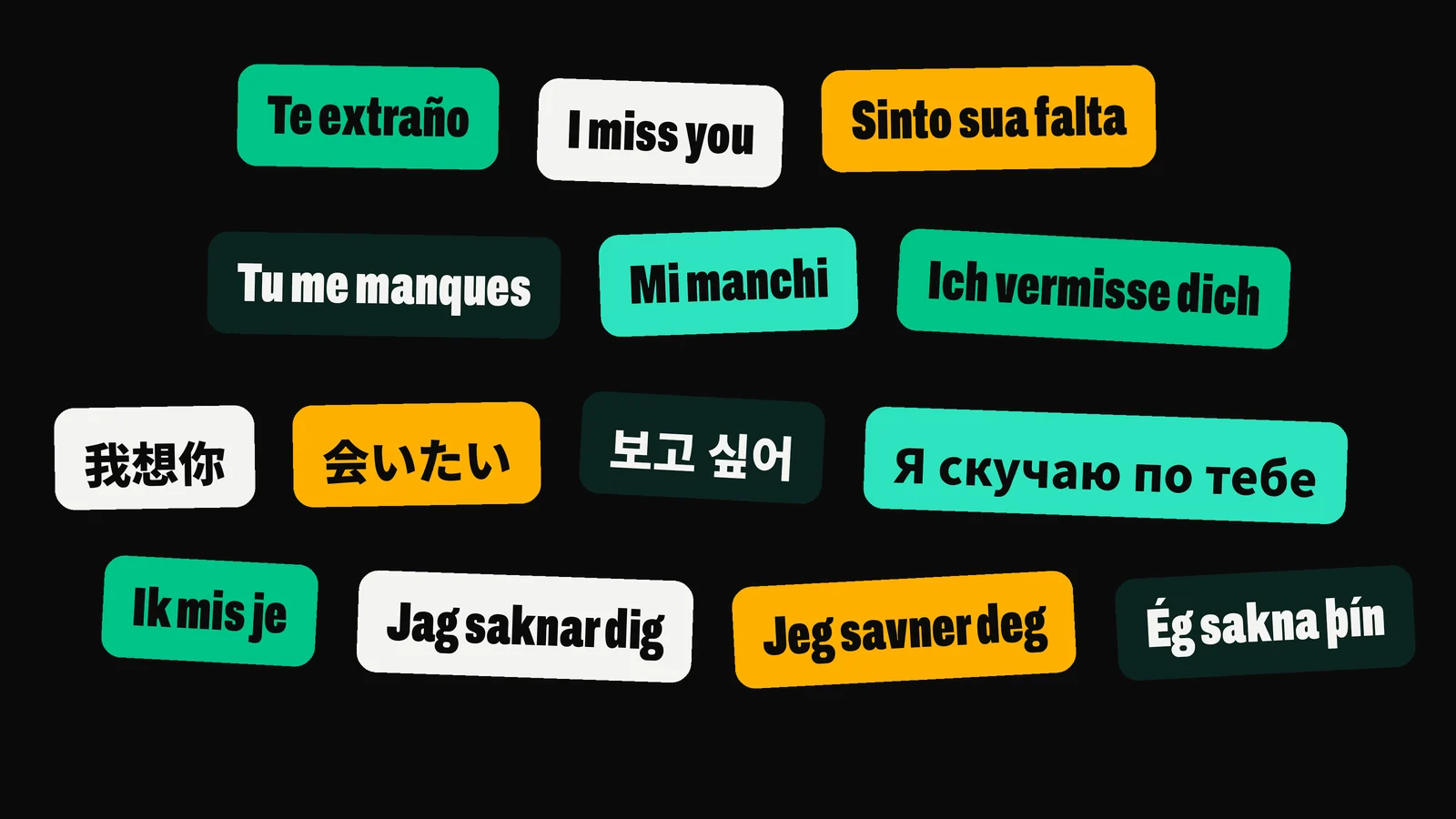
«I miss you» looks easy to translate. Find the matching verb and you're done. But when you look at how each language actually says it, something more interesting shows up: not every language thinks about longing in the same way.
In some, the other person is what you lack. In others, what you say is that you want to see them. And in one, the same verb means both missing someone and being bored.
The full list
| Language | Phrase | Word by word |
|---|---|---|
| Spanish | Te extraño / Te echo de menos | The second one is more common in Spain |
| Portuguese | Sinto sua falta | I feel your absence |
| French | Tu me manques | You are missing from me |
| Italian | Mi manchi | You are missing to me |
| German | Ich vermisse dich | I miss you |
| Dutch | Ik mis je | I miss you |
| Swedish | Jag saknar dig | I lack you |
| Norwegian | Jeg savner deg | I lack you |
| Icelandic | Ég sakna þín | I lack you |
| Russian | Я скучаю по тебе (ya skuchayu po tebe) | I'm bored for you |
| Mandarin | 我想你 (wǒ xiǎng nǐ) | I think of you, I want you near |
| Japanese | 会いたい (aitai) | I want to see you |
| Korean | 보고 싶어 (bogo sipeo) | I want to see you |
When the other person is what's missing
French says it the other way round. In «tu me manques», the subject isn't you, it's the other person: literally, «you are missing from me». That's why it trips up so many French learners. To say «I miss you», the «you» comes first.
Italian does the same with «mi manchi», and German has both versions: «ich vermisse dich» (I miss you) and «du fehlst mir» (you are missing to me). The Scandinavian languages use verbs that also mean to lack something: «sakna» in Swedish and Icelandic, «savne» in Norwegian.
Portuguese has a word of its own for this: saudade, a mix of nostalgia and affection for something or someone that isn't there. «Estou com saudade de você» is the everyday way to say it in Brazil, and it sounds warmer than «sinto sua falta».

When you say you want to see them
Japanese has no direct, everyday translation of «I miss you». The natural thing to say is 会いたい (aitai), «I want to see you». Korean does almost the same with 보고 싶어 (bogo sipeo), «I want to see».
It's a lovely change of focus. Instead of talking about the gap, you talk about what you want. And said to someone, it's just as clear.
Other routes: thinking and being bored
In Mandarin, 我想你 (wǒ xiǎng nǐ) uses the verb 想, which can mean to think, to want or to miss, depending on the context. It's like saying «I'm thinking of you» and «I want you here» at once.
Russian is even more curious. Я скучаю по тебе uses the verb скучать, which also means to be bored. Missing someone, in Russian, sounds a lot like being bored without them.
What this tells us
Learning a language isn't just swapping words. Every language has its own habits for saying things, and a phrase as short as «I miss you» already shows it. That's why it pays to learn whole phrases the way people actually say them, instead of translating word for word.
That's what you practice in Colibrí: you talk with an AI tutor in the language you're learning, and when something sounds like a literal translation, the correction shows you how a native speaker would say it, without stopping the conversation.
Keep reading
-
Learning
How long does it take to learn a language? What the hours say
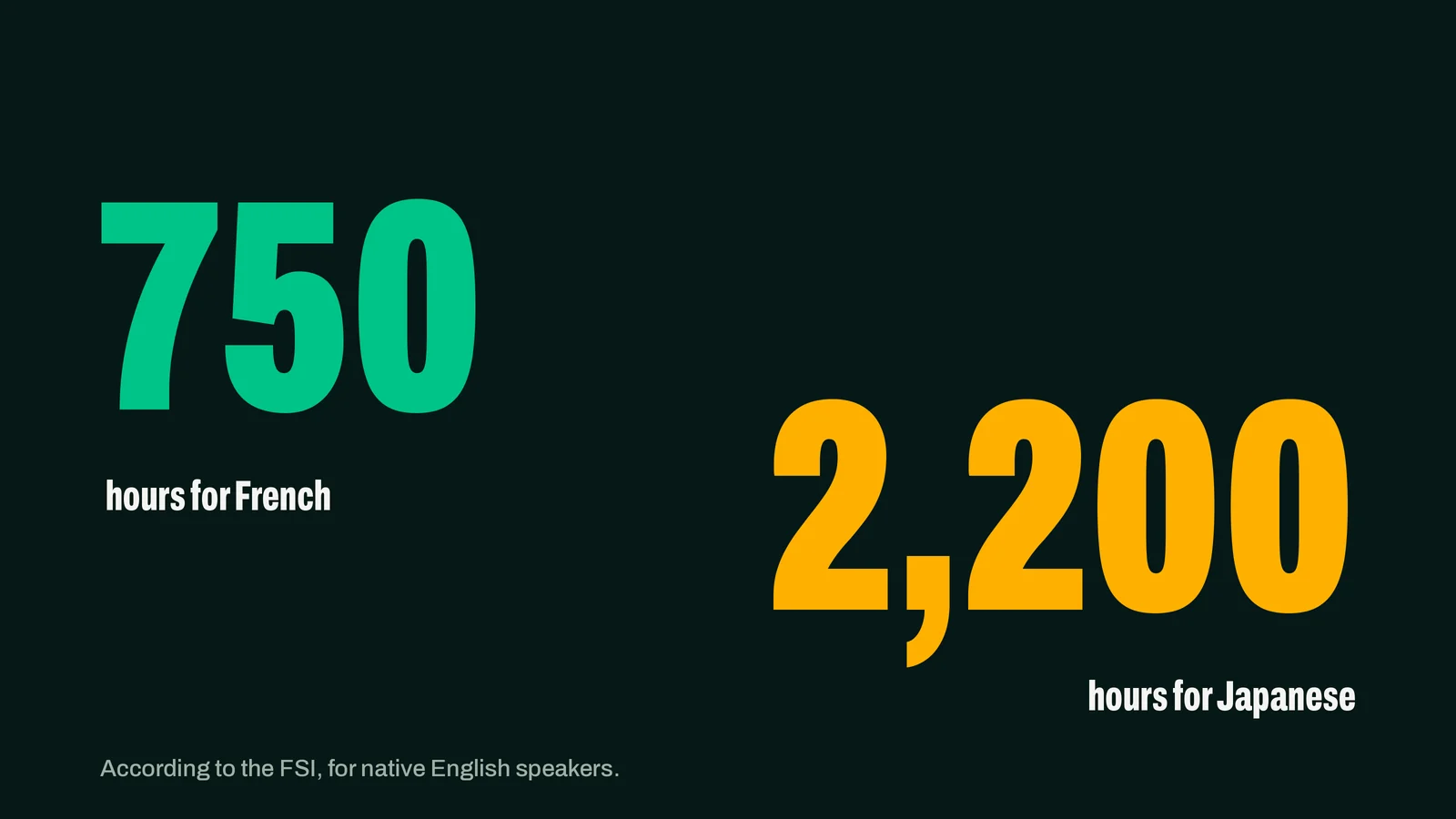
The U.S. Foreign Service Institute estimates 600 to 2,200 class hours depending on the language. What those numbers mean, what they leave out and how to do your own math.
Read -
Speaking
Why you understand a language but can't speak it
Understanding and speaking are different skills. Here is why you freeze when it's your turn to talk, five habits that help, and a two-minute exercise for today.
Read